INDUSTRY:
TELECOM
CLIENT:
VODAFONE
YEAR:
2023
ROLE:
SENIOR EXPERIENCE DESIGNER

Vodafone Digital Platform
overview.
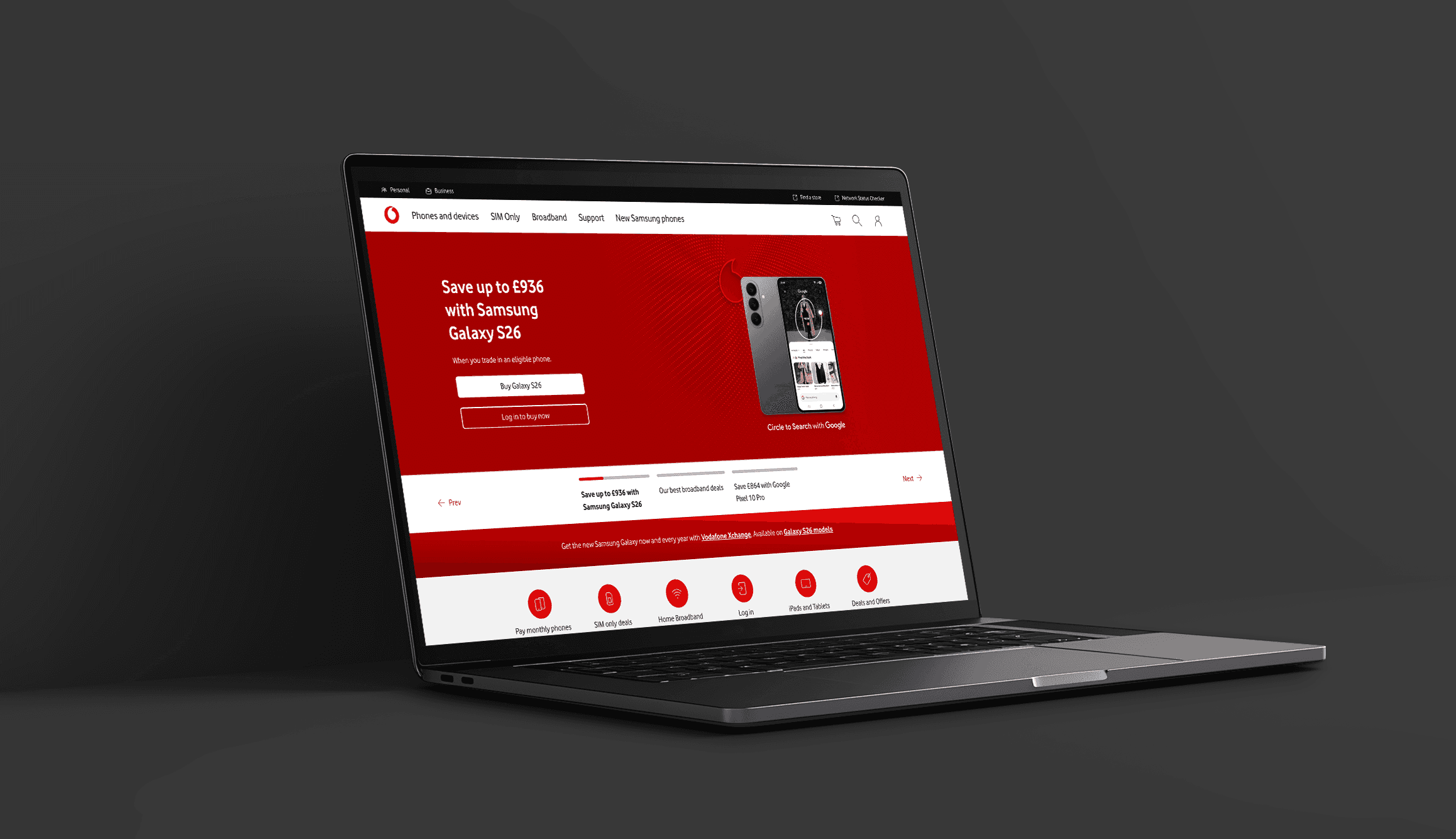
Vodafone UK is one of the country's most recognised telecoms brands, serving millions of customers across mobile, broadband, and connected devices. When I joined the engagement through MSQ's experience design practice, the challenge wasn't rebuilding from scratch; it was something harder: bringing rigour, coherence, and scalability to a sprawling digital estate that had grown faster than its foundations. Across high-traffic acquisition journeys, device PDPs, pay monthly catalogues, broadband landing pages, network tooling, inconsistencies in component logic, interaction patterns, and design token usage were creating friction for both users and the teams building for them. The opportunity was to consolidate the design system and elevate the craft of key customer journeys without disrupting a live, commercially critical platform.
challenge.
Vodafone's digital presence had accumulated the kind of complexity that comes with scale and speed: multiple teams shipping independently, component libraries that had forked over time, and a design system that existed more as a reference artefact than a living governance framework. The system's token architecture was inconsistent, colour, spacing, and typography decisions were being made locally rather than inherited, and there was no shared language for what constituted a "canonical" component versus a one-off variant. For a brand operating across mobile, broadband, devices, and wearables, this wasn't just an aesthetic problem. It was a velocity problem, a quality problem, and increasingly a brand coherence problem.
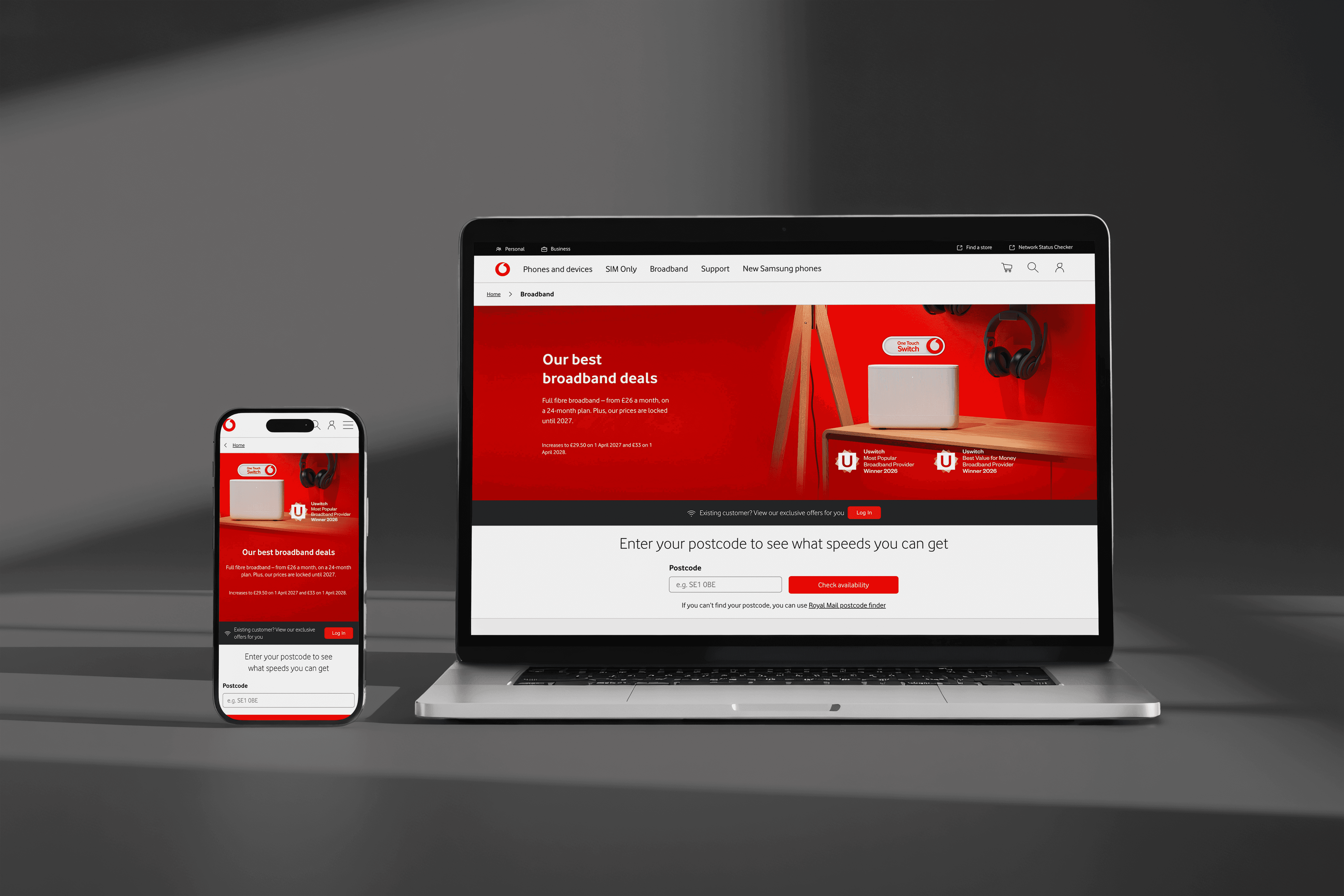
At the same time, several of the customer-facing journeys were showing the strain. The device product detail pages, particularly high-stakes, high-traffic pages like the iPhone 17 Pro Max, were rich with information but lacked a clear hierarchy. Plan selectors, trade-in mechanics, comparison tables, and feature storytelling were competing for attention rather than working in sequence. The broadband acquisition flow faced similar challenges: postcode-gated entry, plan comparison, and benefit communication needed to work as a coherent journey, not a sequence of disconnected page sections.

my role.
I joined as a senior experience designer with a remit that spanned both the systemic and the experiential, which suited the project's actual needs. On the design system side, I led planning. I contributed directly to the technical implementation documentation: defining token hierarchies, establishing component naming conventions, and producing governance frameworks that gave distributed teams clear decision-making criteria. This wasn't theoretical work; it required deep collaboration with front-end engineers to ensure the token architecture mapped cleanly to code, and with design leads to secure buy-in for a more disciplined approach to component creation and deprecation.
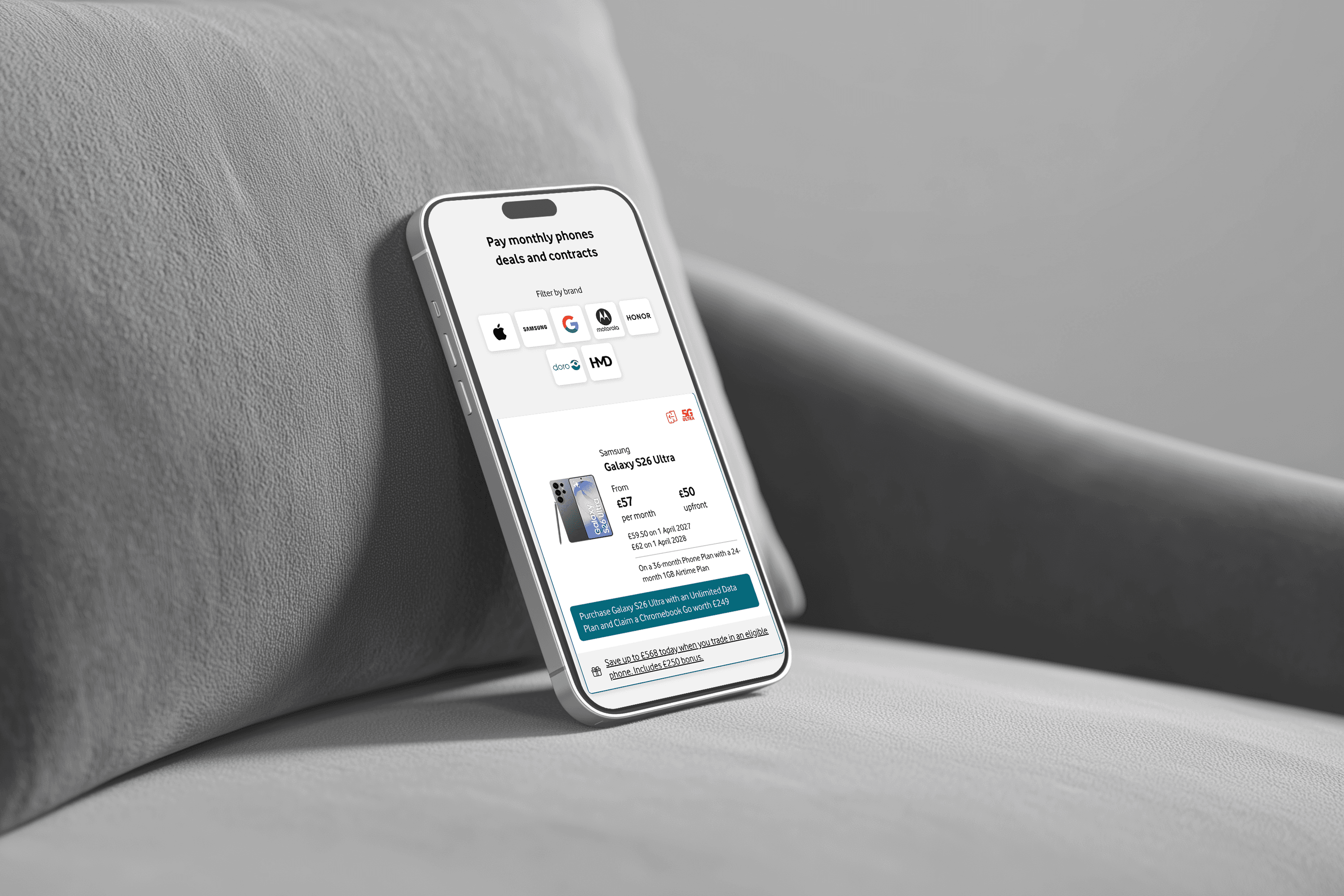
In parallel, I worked as a hands-on designer on several of the platform's key journeys, including the device PDP, the pay monthly catalogue, and network tooling pages. Here my contribution was both strategic and executional: shaping the information architecture, designing interaction patterns, and working through the detail of how progressive disclosure, filtering logic, and cross-sell mechanics should behave across device breakpoints. The dual nature of the role, system architect and journey designer, meant I could spot where systemic decisions were creating experience problems, and vice versa.

approach.
Discovery began with a pattern inventory rather than a gap analysis, cataloguing not just what existed in the component library, but how the same design problem had been solved differently across the estate. The iPhone PDP and smartwatch catalogue shared structural needs (hero, plan selector, feature storytelling, related devices) yet had diverged significantly in implementation. Those divergences became my prioritisation map for consolidation.
For the design system, I structured the token architecture across three tiers:
Global tokens - brand primitives: colour, scale, typography
Semantic tokens - purpose-assigned values such as
color-surface-primaryorspacing-component-mdComponent tokens - consuming from semantic rather than global values, so theme changes propagate without component-by-component edits
Alongside the token work, I produced governance documentation defining component lifecycle rules: proposal criteria, design review checkpoints, deprecation pathways, and versioning conventions. Getting teams to adopt this required as much facilitation as it did design craft.
On the journey side, I applied jobs-to-be-done framing to interrogate what customers were actually trying to accomplish, rather than optimising the existing page structure in place. Key interventions included:
Broadband flow - restructured the postcode entry and plan comparison sequence to reduce cognitive load at commitment, surfacing speed tiers and switching incentives earlier
Device PDP - applied progressive disclosure to the plan-building module, surfacing the most relevant contract choices first and deprioritising edge-case options that were adding noise
Catalogue pages - standardised filtering logic and plan comparison patterns across device and wearable categories for a more consistent browsing experience
Throughout, I stayed in close alignment with engineering to ensure the interaction models mapped cleanly to the component system we were simultaneously consolidating, so that the journey work and the system work reinforced each other rather than running in parallel.

outcome.
The design system consolidation delivered measurable structural change. Token architecture documentation was adopted across product and engineering teams, component duplication fell significantly, and the governance framework gave distributed teams a shared vocabulary for design decisions, reducing the back-and-forth that had previously slowed handoff cycles. For a platform of Vodafone's scale, systemic investment compounds: every journey built on a coherent foundation is faster to design, easier to maintain, and more consistent in execution.
The experience improvements on key journeys translated into tangible commercial results. The broadband acquisition flow saw meaningful uplift in completion and satisfaction scores; the device PDPs became more navigable as cleaner information hierarchy reduced competition between feature storytelling, social proof, and transactional mechanics.
What this project ultimately unlocked was a design practice better equipped to move at commercial speed without sacrificing quality, a digital experience that earns trust at every interaction, and an organisation capable of sustaining it.
reflection.
What made this project meaningful wasn't the scale of the platform; it was the rigour required to serve it well. Design systems work is invisible when it's done right, and that's precisely the point: the care goes into the structure so that the experience can feel effortless. Getting to operate across both the systemic and the experiential on the same engagement reminded me that craft, at its best, is always both.