INDUSTRY:
TELECOM
CLIENT:
THREE MOBILE
YEAR:
2025
ROLE:
SENIOR PRODUCT DESIGNER

My3 App
overview.
Mobile network apps occupy an awkward space: they need to be both utility and relationship, a place customers manage bills and a place they feel genuinely valued by their provider. Three's My3 app had grown organically over the years, and the cracks were showing. Individual journeys, top-ups, upgrades, bill management, and account access each worked in isolation, but the overall experience felt fragmented, effortful, and distinctly unbranded. The opportunity wasn't just to tidy things up. It was to redesign the app as a unified, emotionally coherent product that could earn daily relevance in customers' lives, and to lay the groundwork for absorbing Three+, a standalone rewards app, into a single, seamless experience.
challenge.
The core challenge wasn't any one journey; it was the accumulated friction of many. Years of feature accretion had left My3 without a coherent information hierarchy. Customers couldn't easily answer basic questions: Can I upgrade now? What will I actually pay? Where are my rewards? Each question required navigation that didn't map to how people think about their relationship with their network. The upgrade flow alone spanned multiple screens with competing calls to action, unclear pricing breakdowns, and no personalisation despite Three holding rich customer data that could have made the experience feel considered rather than generic.
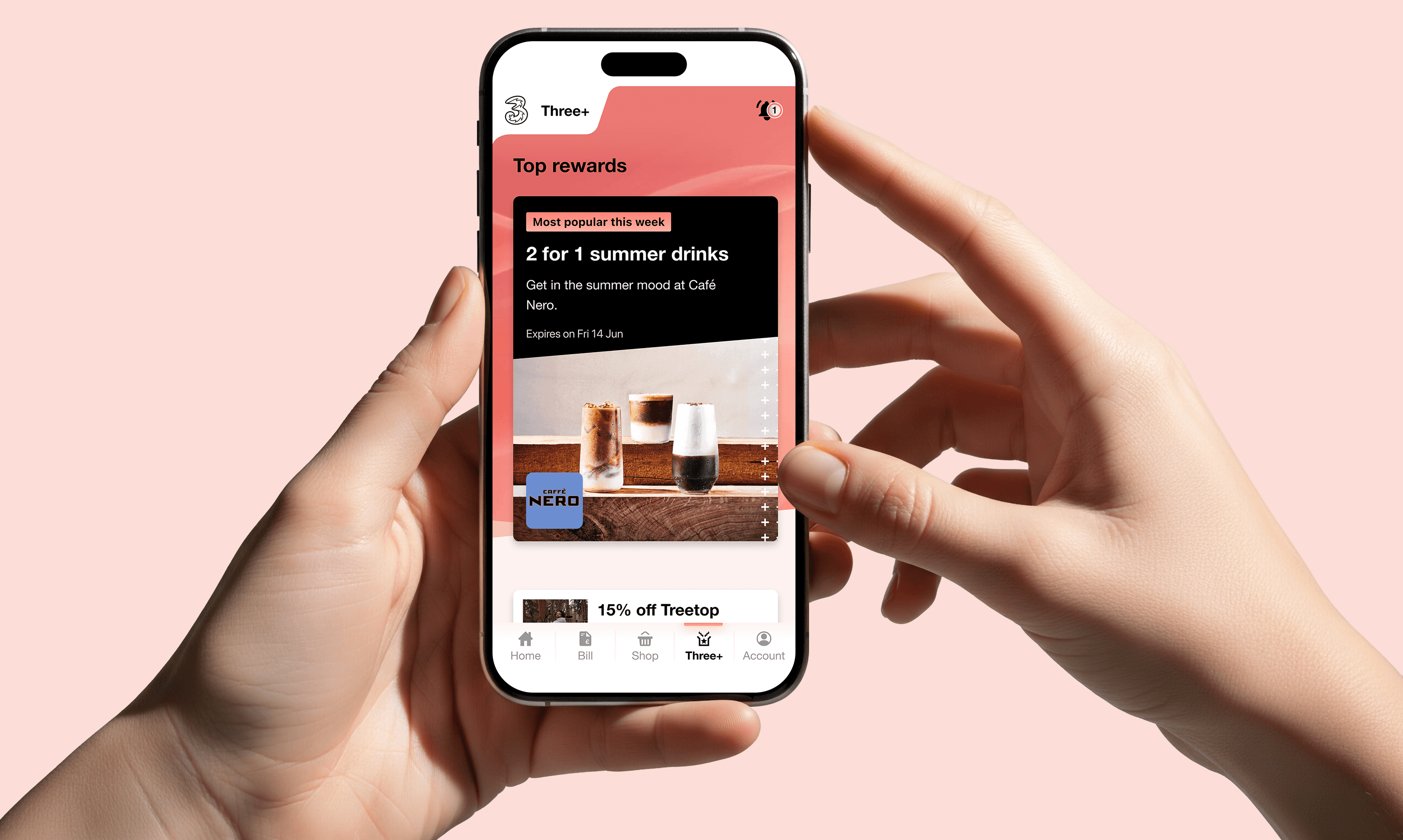
The integration of Three+ added another layer of complexity. As a standalone app, Three+ had its own design language, navigation model, and content strategy. Bringing it into My3 wasn't just a technical migration; it required a fundamental rethink of how rewards fit into the broader account experience without either burying them or letting them dominate. The political dimension was real too: two separate product teams, two sets of stakeholders, and a shared deadline that created constant pressure to scope down rather than solve the right problem.
my role.
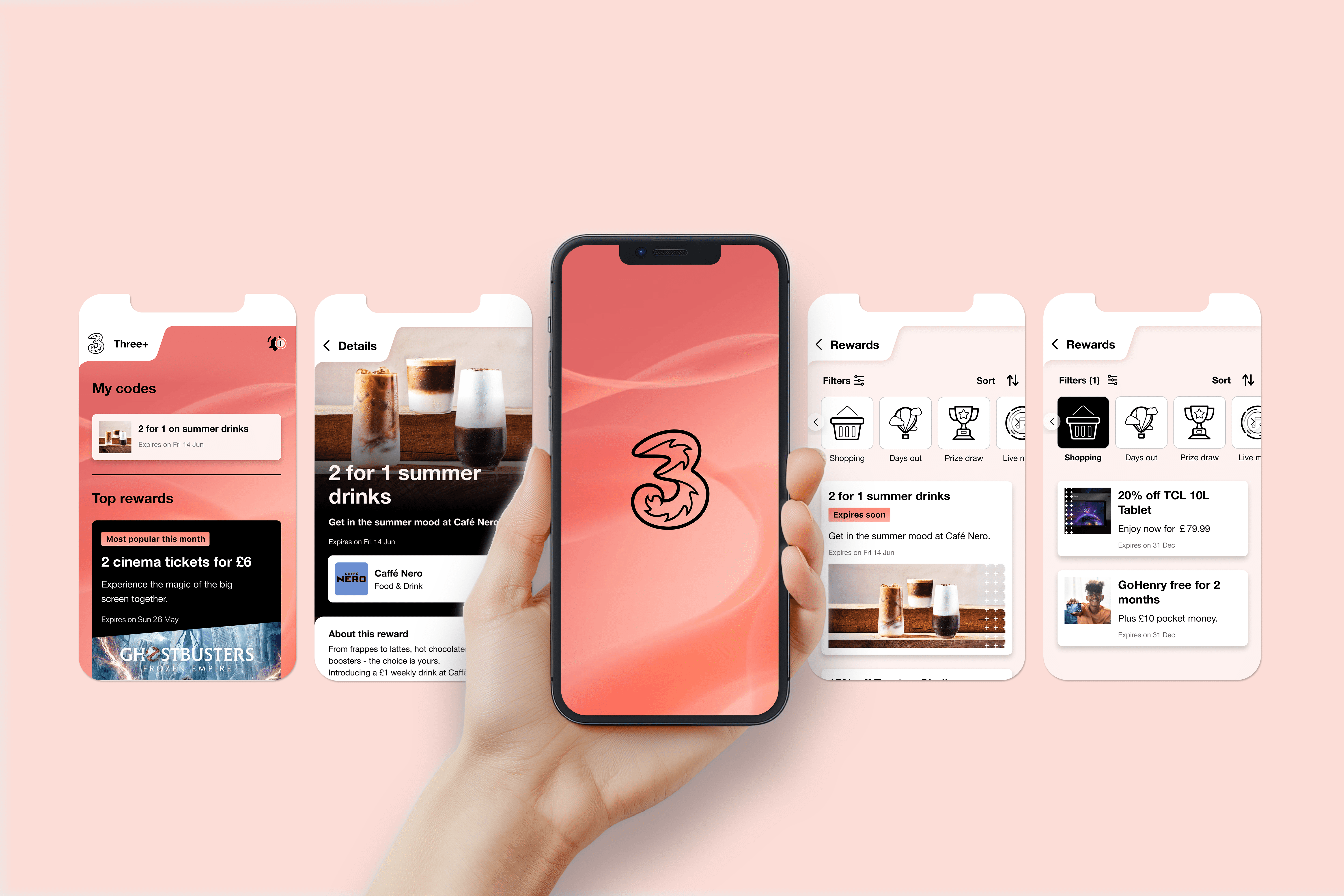
I joined as one of the senior product designers on the project, embedded within a cross-functional squad covering product, engineering, and CX strategy. My ownership spanned the upgrade journey end-to-end, from the personalised device recommendation surface through to payment confirmation, as well as the Three+ integration architecture, which I led from a design perspective. I also contributed to the design system work that underpinned the entire redesign: establishing token structures for the new visual language and working closely with the component library team to ensure consistency across all five core sections of the app.
Beyond delivery, I operated as a strategic voice in shaping the product direction. I ran discovery workshops with the CX research team, facilitated jobs-to-be-done framing sessions with product leadership, and pushed back on several proposed scope reductions where I felt we were optimising for short-term delivery at the cost of long-term coherence. That tension, between shipping something and shipping something right, defined a lot of my contribution on this project.
approach.
Discovery started with existing data, not blank-slate research. Support ticket analysis, session recordings, and funnel drop-off reports gave us a precise picture of where people were struggling before we spoke to a single user. A consistent pattern emerged: customers understood what they wanted to do but couldn't navigate confidently to get there, and when they did, the language and structure didn't match their mental model.
I ran co-design sessions with retail staff and support agents who had absorbed thousands of real customer conversations. Their input sharpened our priorities faster than any lab session could. Key decisions that came directly from this phase:
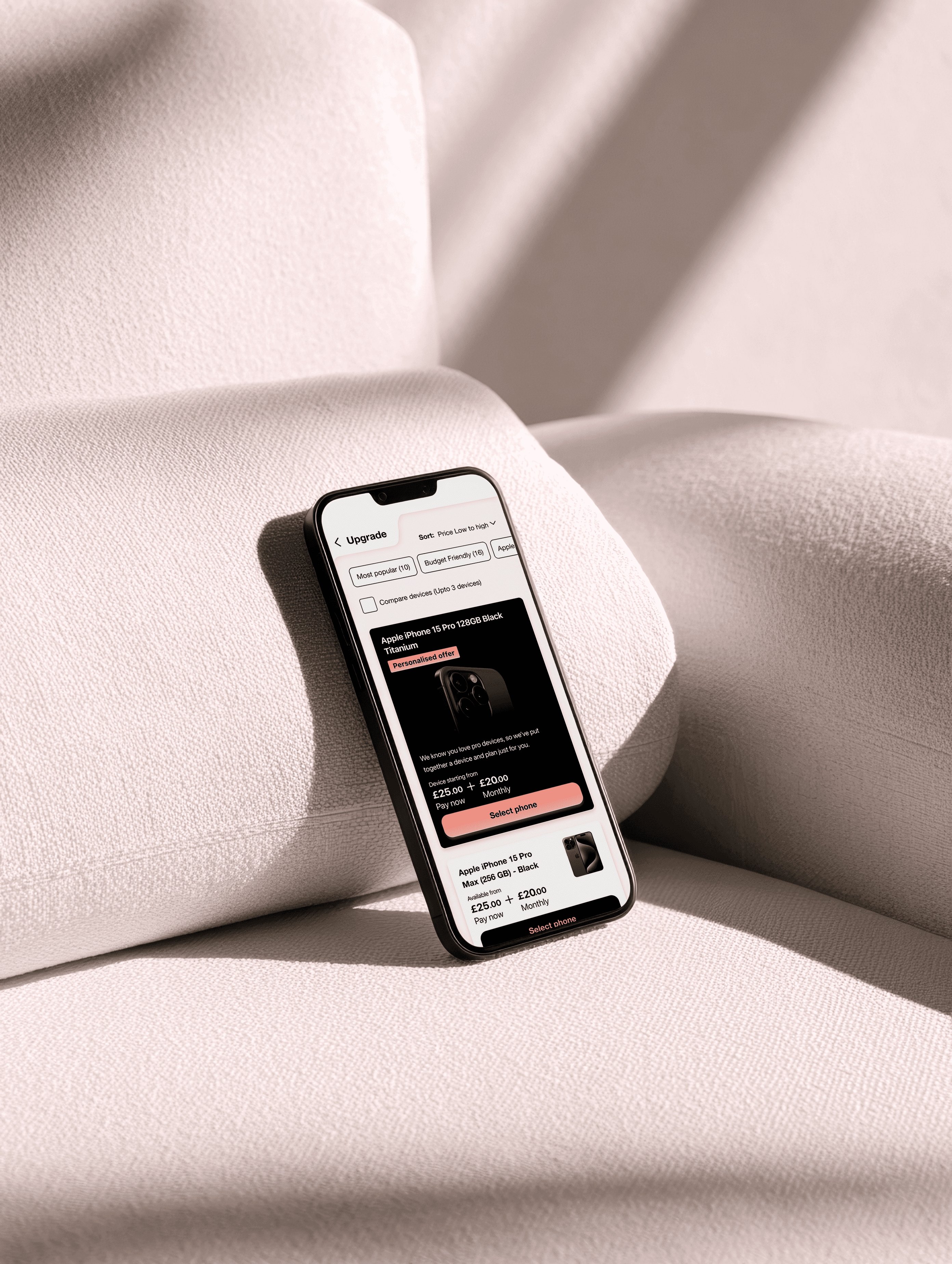
Lead with personalisation - customers shown a tailored device recommendation were significantly more likely to complete a purchase, so we redesigned the upgrade entry point around that signal
Restructure pricing presentation - pay-now and monthly costs displayed in parallel, with trade-in surfaced early, to reduce the anxiety that was killing conversion mid-flow
Simplify the account landing - organised around the questions customers actually ask, not the internal taxonomy the business had inherited
For the Three+ integration, the central question was navigational: where do rewards live without feeling buried or disconnected? We tested three models: standalone tab, nested within account, contextual home screen surfacing, with existing Three+ users. The dedicated tab won clearly. It preserved the habit loop already established in the standalone app while elevating rewards to a first-class feature of My3. The design challenge then shifted to visual tone: Three+ needed to feel editorially warm and distinct from the transactional sections of the app, while sharing the same underlying token architecture.

outcome.
The upgrade flow moved from a linear, low-context browse to a personalised, progressively disclosed experience, showing customers the most relevant device first, surfacing eligibility status clearly, and presenting pricing in a format that matched how people actually compare options. Confusion dropped; confidence in the decision increased.
Account and billing were restructured around the questions customers actually ask. A cleaner information hierarchy, setup completion states, and quick-access utilities reduced cognitive load from the moment of landing. The visual refresh, rooted in Three's warm coral and clean typographic system, finally made the app feel coherent with the brand customers already knew.
The Three+ integration was designed and validated for technical handover. The tab-based architecture is in the pipeline, and the work demonstrated that rewards and account management can coexist in a single product without either compromising the other, laying the foundation for My3 to become something genuinely differentiated in the UK telco market.
reflection.
What I find most interesting about this kind of work is that the design problem is never really about screens; it's about trust. When someone opens their network app, they want to feel looked after, not lost. Every decision we made on My3, from the token structure to the placement of a personalised offer, was ultimately in service of that feeling. Getting it right takes patience, precision, and a willingness to hold the line when the easier answer is also the wrong one.