INDUSTRY:
TRANSPORT
CLIENT:
TRANSLINK
YEAR:
2023
ROLE:
SENIOR EXPERIENCE DESIGNER

Translink Digital Experience
overview.
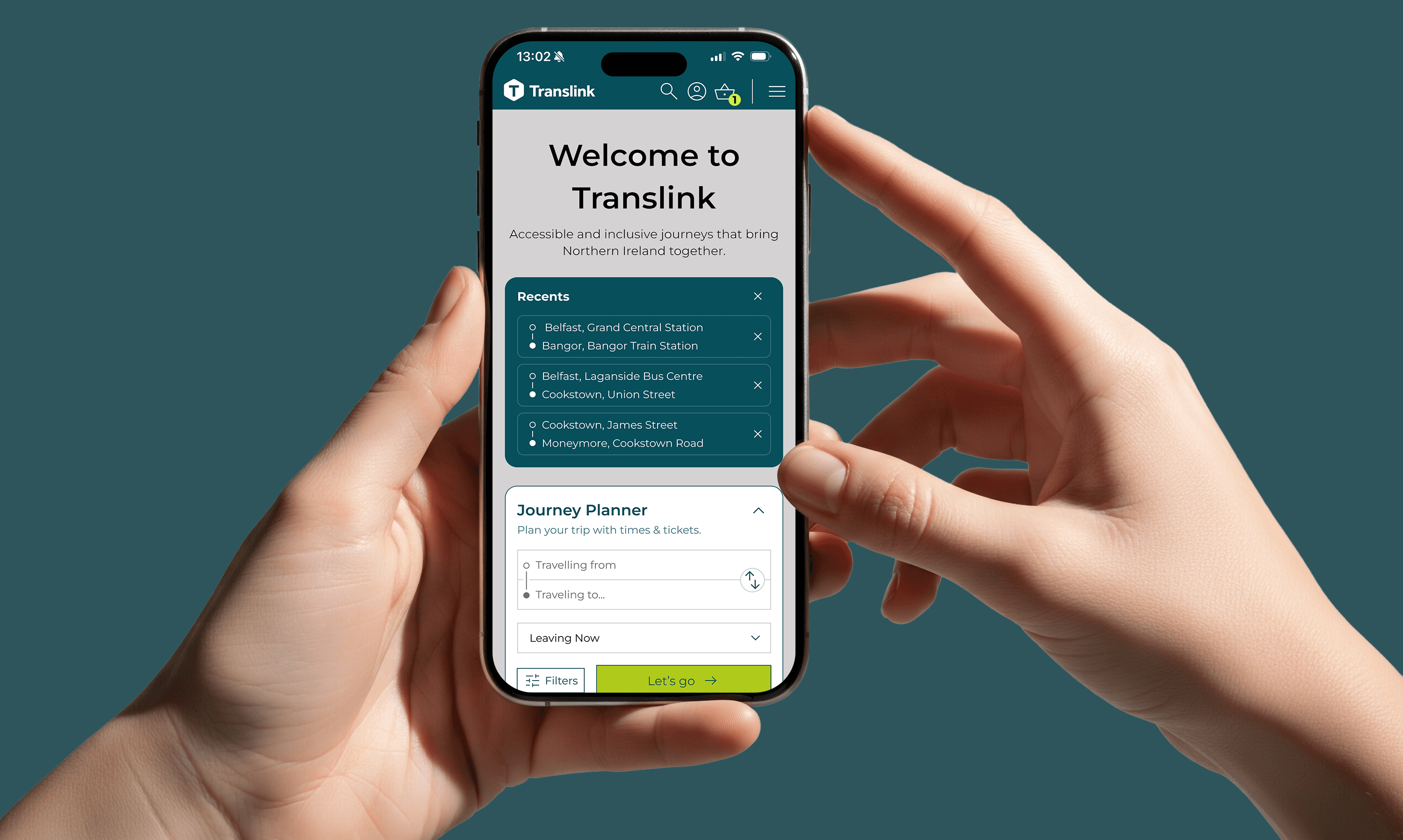
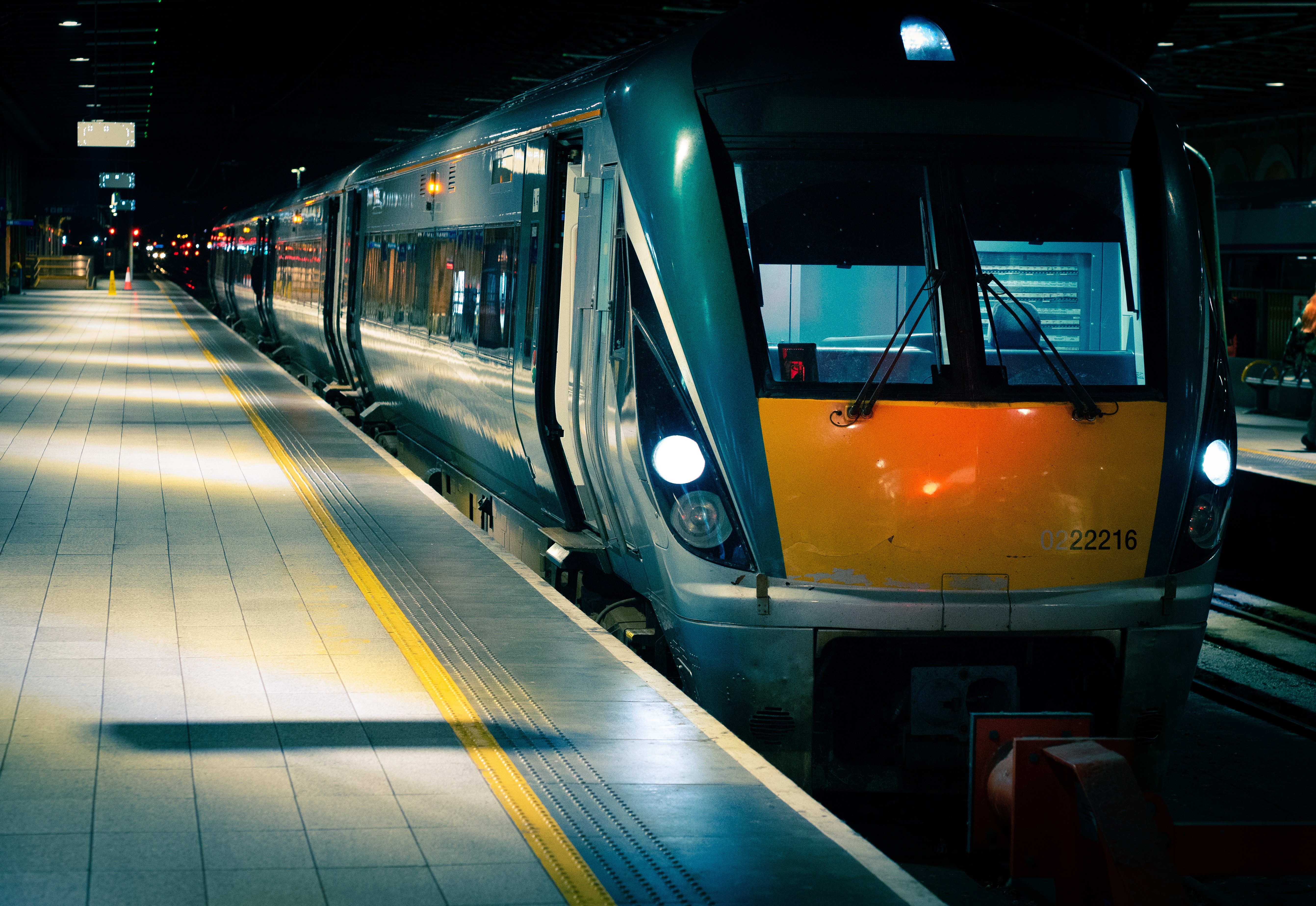
Translink is Northern Ireland's primary public transport operator, with bus, rail, and cross-border services connecting millions of journeys each year. When the organisation set out to redesign its digital presence, the challenge was never simply cosmetic: the existing platform sat at the intersection of fragmented legacy systems, a complex multi-modal network, and a passenger base ranging from daily commuters to first-time tourists. The stakes were real. Getting this wrong meant people missing trains, choosing cars, or simply giving up on public transport altogether. The opportunity was to transform a transactional, difficult-to-navigate experience into something genuinely service-led. This digital platform could earn trust, reduce friction, and reflect the ambition of an organisation modernising public life in Northern Ireland.
challenge.
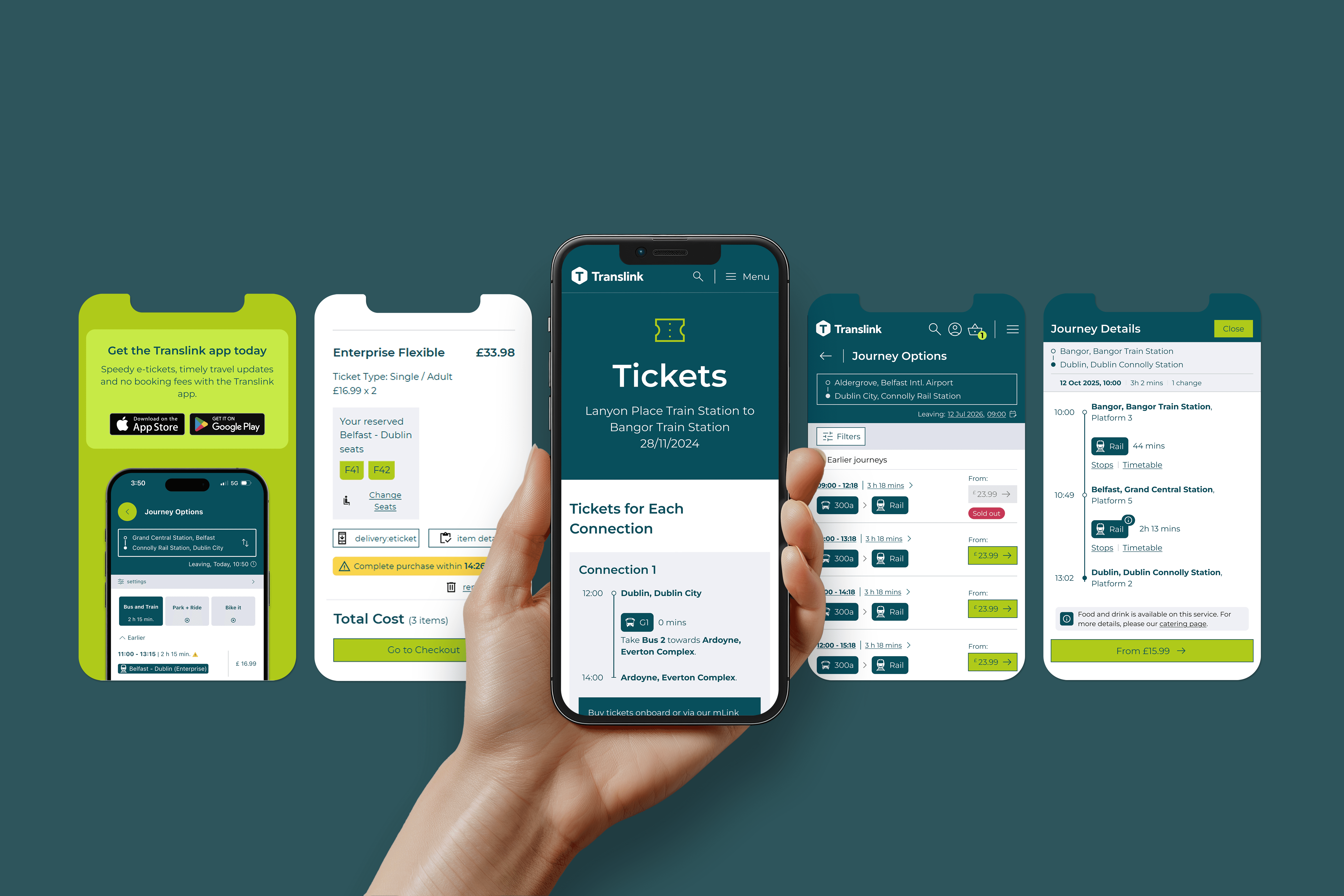
Translink's digital estate had grown organically over many years, a patchwork of systems reflecting distinct historical decisions about bus, rail, and cross-border ticketing rather than a coherent passenger experience. The journey planner and ticketing flow existed as largely separate concerns, meaning a user planning a multi-leg journey involving the Glider, NIR rail, and the Enterprise cross-border service encountered a different logic, different terminology, and a different interaction model at each turn. Ticket types - iLink, NIR Single, Day Return, mLink - carried operational meaning that meant little to a casual user standing on a platform with a train leaving in three minutes.
Alongside the product complexity, the project carried significant organisational weight. Translink serves a public with genuine accessibility needs, operates under regulatory and procurement constraints, and must communicate clearly to passengers across a wide literacy spectrum. Any solution had to hold up under those conditions, not just in controlled testing, but in stations, on buses, in bad weather, on slow connections. The design challenge was to reconcile enterprise-grade complexity with consumer-grade clarity, without simplifying the product to the point of uselessness.
my role.
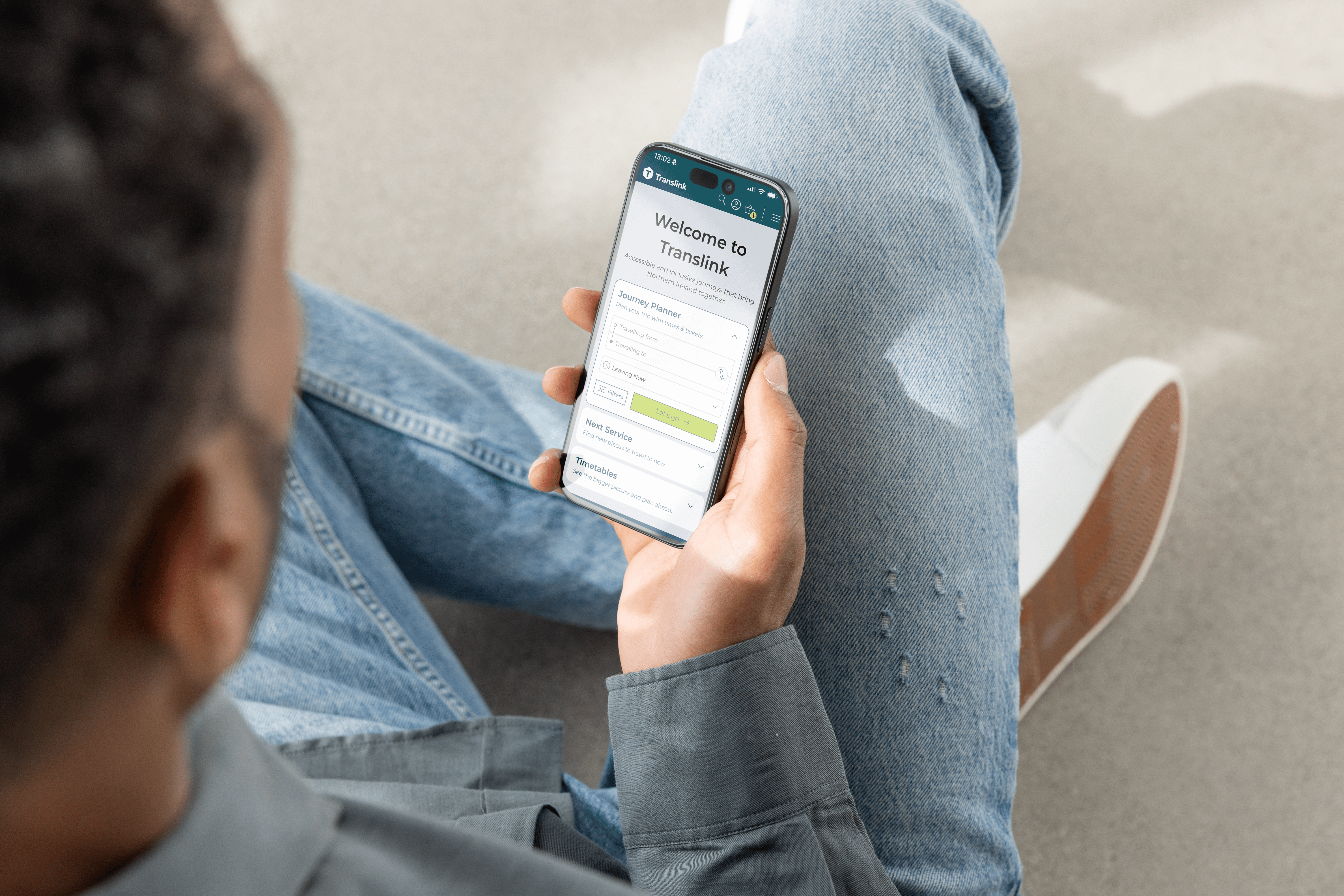
I joined the project as Senior Experience Designer, embedded within a cross-functional team spanning strategy, engineering, and content. My ownership sat across the end-to-end journey planning and ticketing experience, from the homepage entry point through to basket and checkout, with particular depth of responsibility on mobile, where the majority of real-world passenger interactions were happening. I led the UX architecture, interaction design, and the translation of business and operational logic into interface decisions that passengers could actually parse under pressure.
Beyond execution, I acted as the primary design voice in stakeholder conversations, framing design recommendations in terms of passenger outcomes and service performance rather than aesthetic preference. This meant navigating competing priorities, commercial, operational, accessibility, and technical, and finding the ground where good design and viable delivery met. I worked closely with engineering throughout, treating feasibility as a design constraint rather than a late-stage concern, and shaped the component logic that would allow the interface to flex across the full complexity of Translink's network.
approach.
Discovery began not in workshops but at stations — understanding what it felt like to use the platform rushed, distracted, on a weak signal. I used jobs-to-be-done framing to cut through the product catalogue complexity: passengers don't want to buy a ticket, they want to get somewhere without stress. The journey planner became the product's true front door — not just a feature, but the primary trust signal for the entire platform.
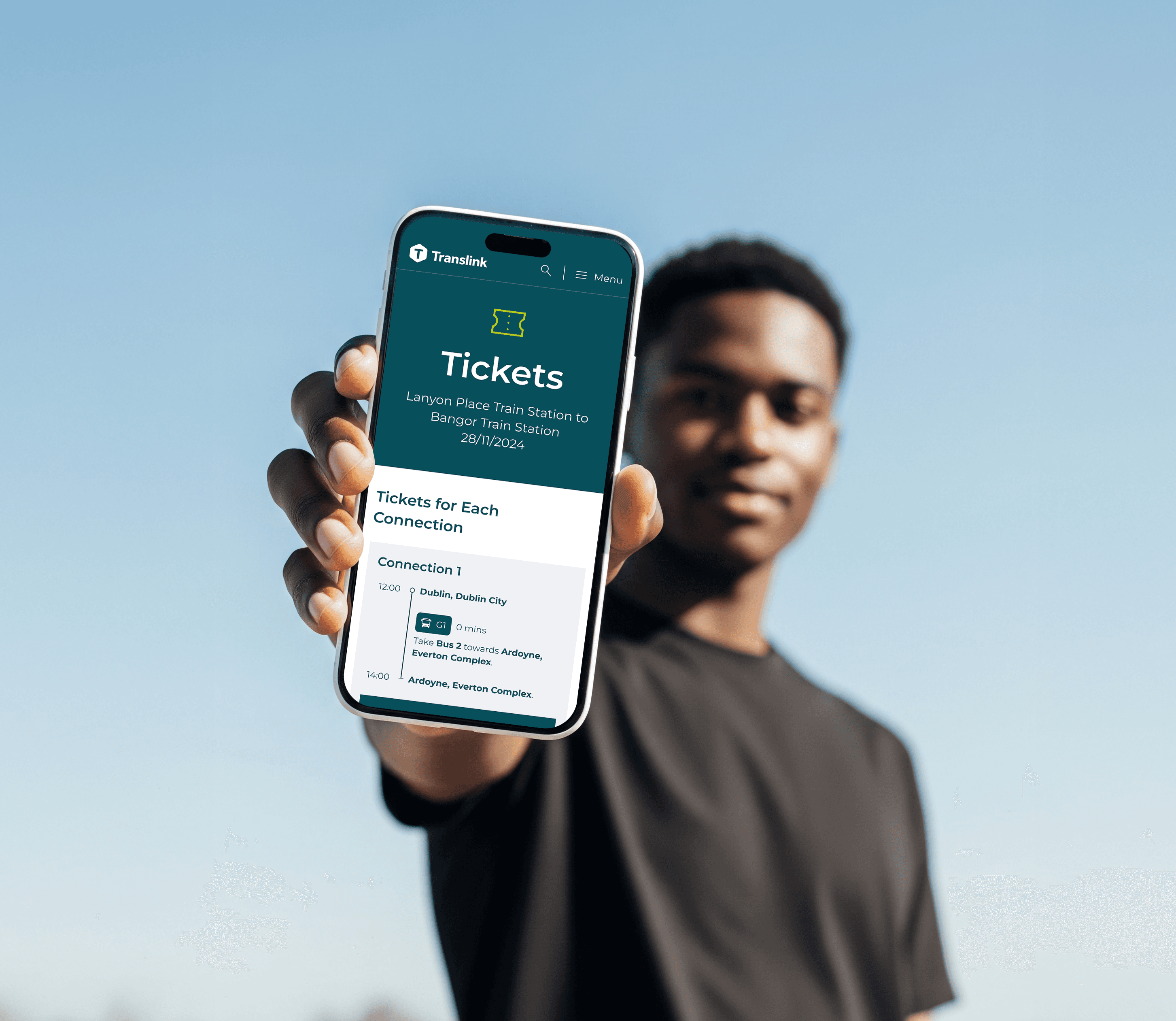
The multi-connection ticket pattern was the hardest structural problem. A journey from the Airport to Dublin via Grand Central spans two separate ticketing contexts, each with its own product range. My approach:
Progressive disclosure - connection-level detail surfaces only when relevant, keeping the journey list fast and scannable
Consistent connection labelling - (Connection 1, Connection 2) as a spatial grammar passengers could follow without needing to understand the logic beneath
A "Your selection" summary screen - that held the full picture before committing to basket
Accessibility shaped every decision, not as a compliance layer but as a clarity test. If a screen couldn't communicate its primary action under low vision, low literacy, or high cognitive load, it wasn't ready. Usability testing with older passengers, irregular travellers, and screen-reader users drove several significant revisions before a line of production code was written.

outcome.
What launched was a mobile-first platform that handled Translink's full operational complexity without passing that complexity to the passenger. The 78% improvement in journey planning speed wasn't incidental; it was the direct result of every friction point we'd identified and removed.
The 50% reduction in support enquiries tells the deeper story: a system legible enough at scale that passengers no longer needed help to understand what they'd bought. The 86% increase in monthly digital usage confirmed that clarity drives adoption.
Beyond launch, the work left a reusable design foundation, component patterns, IA principles, and an interaction vocabulary that shifts the ongoing conversation from displaying products to serving the journey.
reflection.
Public transport design is unusually high-stakes; get it wrong and people miss trains, give up, or stop trusting the service entirely. What I valued most about this project was that the complexity was real, the users were real, and the criteria for success were clear: does it work when someone is rushed, uncertain, and standing on a platform in the rain? Designing for that moment, rather than for an idealised user in an idealised context, is where the work got genuinely interesting.